Marriage Registration
📅 2026 Update: Recent Changes in Marriage Registration
There have been no significant updates in U.S. marriage laws from 2024 to 2026. This means the information about marriage certificates, licenses, prenuptial agreements, and similar topics remains largely unchanged. The earlier article continues further down the page, providing essential details for understanding marriage registration and related laws.
📄 Changes in Marriage Certificates
Marriage certificates have remained a crucial document for legally recognizing a marriage. Couples still apply for them at the vital records office where their marriage took place. Requirements like identification and fees have not changed significantly, but it's always wise to check local regulations for any minor updates.
👫 Marriage Counseling Availability
Marriage counseling continues to be a valuable resource for couples. Various nonprofit organizations and community centers still offer free or sliding-scale services. These options help couples improve their relationships without financial strain, maintaining the same principles as before.
📜 Marriage Licenses and Their Requirements
The process of obtaining a marriage license has not changed much. Couples still need to apply at a county clerk's office, providing valid ID and proof of residency. States may still have waiting periods and expiration dates for marriage licenses, so it's essential to stay informed about local rules.
📋 Prenuptial Agreement Validity
Prenuptial agreements remain an important tool for couples planning to marry. They must still be in writing, signed by both parties, and executed voluntarily. Some states continue to require full disclosure of assets for the agreement to be valid, so couples should consider this when drafting their contracts.
📌 Summary of Key Points
- 🗂️ Marriage certificates are still required for legal recognition.
- 💬 Counseling services remain available, including free options.
- 📝 Marriage licenses require valid ID and may have waiting periods.
- 📑 Prenuptial agreements must meet specific legal requirements.
- 💑 Same-sex couples have the same rights as opposite-sex couples.
💡 Tips for Navigating Marriage Registration
Before proceeding with marriage registration, consider going over the details of your specific situation with your attorney.
🗂️ Understand Your State's Requirements
Each state has its own requirements for marriage licenses. Familiarize yourself with these rules to ensure a smooth application process. Knowing what documents you need can save time and reduce stress.
📅 Be Aware of Waiting Periods
Many states impose waiting periods between applying for and receiving a marriage license. Check your state's regulations to avoid delays in your plans. This can help you schedule your ceremony without any last-minute changes.
💵 Budget for Fees
Marriage licenses often come with fees that can vary by location. Make sure to budget for these costs when planning your wedding. Some states may also have additional fees for obtaining certified copies of marriage certificates.
📝 Consider a Prenuptial Agreement
If you have significant assets or children from previous relationships, a prenuptial agreement may be beneficial. These contracts can clarify asset division and responsibilities in case of divorce. Discuss this option with your partner before marriage.
💖 Utilize Free Counseling Resources
If you think marriage counseling might help strengthen your relationship, explore free or low-cost options in your area. Many community organizations offer these services to assist couples without financial burden.
🏆 Ranked by User Reviews (2026)
This section highlights services related to marriage registration based on Trustpilot data as of October 2026. These services provide resources for obtaining marriage certificates and related needs. Ratings can change over time, and they reflect user experiences, with lower scores often indicating more dissatisfied customers.
🥇 1. VirtualMarriage
VirtualMarriage has been rated 4.9 out of 5 stars. It is known for offering online marriage services, including legal marriage certificates. However, some users reported occasional operational problems, so it's crucial to check recent reviews when considering their services.
🆓 Free Government and Nonprofit Options
Many state and local governments provide free resources for marriage registration. Nonprofit organizations also offer counseling and assistance for couples looking to marry. Explore these options to find services that fit your budget and needs.
🔎 What to Compare When Choosing Marriage Services
- 📜 Certification process: How quickly can you receive your marriage certificate?
- 💰 Fees: What are the costs associated with services?
- 🏢 Location: Are services available online or in-person?
- 📞 Customer support: How responsive is the service to inquiries?
❓ Frequently Asked Questions
❓ What is a marriage license?
A marriage license is a legal document that permits a couple to marry. It must be obtained from the county clerk's office and typically requires valid identification.
💍 How do I apply for a marriage license?
To apply for a marriage license, couples must visit a county clerk's office and provide necessary documents such as ID and proof of residency. Fees may apply, and some states have waiting periods.
📝 What is a prenuptial agreement?
A prenuptial agreement is a written contract signed before marriage that outlines the division of assets and responsibilities in case of divorce or death. It must be voluntarily signed by both parties to be enforceable.
📅 How long is a marriage license valid?
Marriage licenses have an expiration date that varies by state. If not used within the specified period, couples must reapply.
🤝 Can same-sex couples get married?
Yes, same-sex marriage has been legally recognized in the United States since June 26, 2015. Same-sex couples enjoy the same legal rights and responsibilities as opposite-sex couples.
⚖️ How do annulments work?
An annulment is a legal procedure that declares a marriage null and void. Common grounds for annulment include fraud, coercion, or incapacity. The process involves filing a petition with the court.
⚖️ Recent Legal Cases Related to Marriage Registration
Recent court rulings continue to shape marriage registration and related laws. These decisions can influence how marriage licenses and prenuptial agreements are interpreted and enforced.
- Florida court rules against judge in divorce case bias claimDistrict Court of Appeal of Florida · March 31, 2021
- Florida court affirms ruling in Segrest divorce caseDistrict Court of Appeal of Florida · March 31, 2021
- Florida Court Upholds Divorce Ruling in Apesteguy CaseDistrict Court of Appeal of Florida · April 7, 2021
- Florida court reverses divorce ruling over jurisdiction issuesDistrict Court of Appeal of Florida · December 1, 2021
For more recent rulings, feel free to browse more rulings on the news page.
End of October 2026 Update
Marriage Registration: Making Your Union Official and Legal
Marriage is a significant milestone in one's life, a declaration of love and commitment between two individuals. To make a marriage legally recognized and official, registration is a crucial step. Marriage registration is a formal process that establishes the legal status of a marriage, ensuring rights and benefits for the couple. In this article, we will explore the importance of marriage registration, the process involved, and the benefits it provides.
1. Importance of Marriage Registration:
Marriage registration is essential for several reasons. Firstly, it provides legal recognition to the marriage, ensuring that the union is valid in the eyes of the law. This recognition is crucial when it comes to rights and benefits that accompany married life, such as inheritance rights, property rights, health care coverage, and tax benefits. Without proper registration, couples may face challenges in accessing these rights and benefits.
2. Process of Marriage Registration:
The process of marriage registration varies from one country to another, but certain common elements can be found across different jurisdictions. These typically include:
a) Obtaining a marriage license: Couples must apply for a marriage license, which serves as permission to proceed with the marriage. The requirements for obtaining a license may include providing identification documents, completing an application form, and paying a fee.
b) Ceremony and witnesses: The marriage ceremony is typically conducted in the presence of authorized individuals, such as religious officials or civil celebrants. Witnesses are often required to sign the marriage certificate, affirming the legality of the union.
c) Document submission: Following the marriage ceremony, the couple must submit the signed marriage certificate to the appropriate government agency for registration. This step ensures that the marriage is officially recorded and becomes part of the public record.
3. Benefits of Marriage Registration:
Marriage registration offers numerous benefits to the couple. Some key advantages include:
a) Legal protection: Registered marriages provide legal protection to both spouses, including rights related to property, inheritance, and decision-making in case of incapacitation.
b) Health and insurance benefits: Married couples often have access to spousal health care coverage, including medical insurance and retirement benefits. Registration ensures eligibility for these benefits.
c) Tax advantages: Many countries provide tax benefits to married couples, including joint filing and potential deductions. Marriage registration is a prerequisite for availing these advantages.
d) Parental and custody rights: When children are involved, marriage registration becomes vital in establishing legal parental rights and custody arrangements.
e) International recognition: For couples intending to relocate or travel abroad, a registered marriage offers international recognition and simplifies legal processes, such as obtaining visas or immigration benefits.
4. Ensuring Legal Validity:
Marriage registration serves as proof of a legally binding union. Failure to register a marriage may result in it being considered a void or voidable marriage, leaving parties vulnerable to legal challenges or possible annulment.
5. Celebrating Love and Commitment:
Beyond the legal aspects, marriage registration represents a celebration of love and commitment. It formalizes the bond between two individuals and affirms their commitment to each other. By making their union official, couples publicly declare their intention to share their lives together.
Conclusion:
Marriage registration is a vital step in legalizing and formalizing a union. It offers numerous benefits, including rights, protections, and access to various benefits and entitlements. The process may differ across jurisdictions, but the underlying objective remains the same – to make the marriage legally recognized. By undertaking the necessary steps for registration, couples can ensure that their union possesses legal validity, providing them with peace of mind and the ability to fully enjoy the rights and benefits that come with married life.
WHAT IS MARRIAGE REGISTRATION?
In most States, upon the completion of a marriage ceremony and the filing by the marital official of the marriage license, the clerk of the County or City in which the ceremony was performed will automatically send the CERTIFICATE OF MARRIAGE REGISTRATION to the applicants within a specified period of time. The purpose of a MARRIAGE REGISTRATION is to have a recorded document of the completion of the marital act for the public records.
WHAT DO I HAVE TO DO TO RECEIVE A CERTIFICATE OF MARRIAGE REGISTRATION?
The act of obtaining a CERTIFICATE OF MARRIAGE REGISTRATION is somewhat automatic and does not involve any action on the part of the husband or wife. Upon the completion of the marriage ceremony the official performing the marriage will file the completed marriage license with the appropriate clerk's office. Upon the receipt of the marriage license by the clerk's office a CERTIFICATE OF MARRIAGE REGISTRATION will be sent to the marital domicile within fifteen (15) days of the filing of the marriage license.
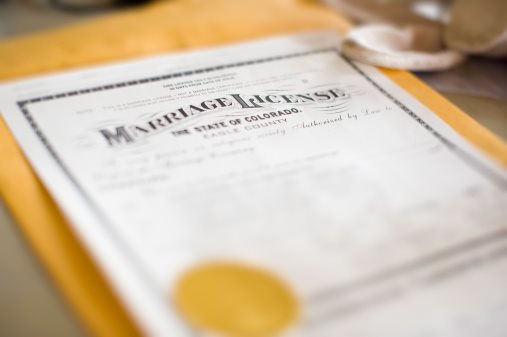
OK I UNDERSTAND THAT BUT WHAT DO I HAVE TO DO TO GET A MARRIAGE LICENSE?
Prior to any kind of ceremony it is required that a couple to be married obtain a marriage license. This is done by going to the clerk's office of your City or County and applying for a marriage license. States differ on what their requirements are for a marriage license but most, at a minimum, require that each individual who is party to the marriage bring with them proper identification, documentation of residency and proof that one is not already married. This last requirement may take the form of certificates of divorce, annulment or proof of death of former spouse. In addition to the documentary evidence required there are also processing fees involved. Most States require a nominal filing fee somewhere in the range of $30 - $50 dollars.
OK, I'VE GOT THAT, IS THERE ANYTHING ELSE?
Yes, in addition to the documentary evidence and filing fees there are a couple of rules that are significant in obtaining a marriage license.
First, in this country the idea of an incestual relationship is highly frowned upon. Therefore the States will not permit individuals who are closely related by blood to wed. As with all marital laws this varies from State to State and there have been a number of situations where the courts have allowed certain marriages, that would otherwise be considered illegal, to be valid due to religious reasons.
Secondly, different States have different laws pertaining to the marriage of minors. The rules change depending on the age of the minor. If you are underage and looking to be married it is best for you to become familiar with the rules on marriage in your jurisdiction.
Finally, a marriage license is not valid forever. Most States have a range of one (1) to three (3) months in which a marriage license is valid. Therefore, it is in your best interest to have done your research and have all documents ready when you apply for your license.
As with any matters that involve State law, these rules differ from jurisdiction to jurisdiction. It is in an individual's best interest to consult their own personal State's marital laws before moving forward with any action.